import matplotlib.pyplot as plt
import matplotlib.patches as mpatches
from collections import defaultdict

class BacktrackingVisualizer:
    """
    Visualiseur de l'arbre de recherche du backtracking.
    Enregistre chaque assignation et backtrack pour affichage.
    """

    def __init__(self):
        self.nodes = []  # Liste des (profondeur, variable, valeur, status)
        self.edges = []  # Liste des (parent_idx, child_idx)
        self.current_path = []  # Chemin actuel dans l'arbre

    def record_assign(self, var, value, success):
        """Enregistre une tentative d'assignation."""
        depth = len(self.current_path)
        node_id = len(self.nodes)
        status = 'success' if success else 'fail'
        self.nodes.append((depth, var, value, status))

        if self.current_path:
            parent_id = self.current_path[-1]
            self.edges.append((parent_id, node_id))

        if success:
            self.current_path.append(node_id)

        return node_id

    def record_backtrack(self):
        """Enregistre un backtrack."""
        if self.current_path:
            self.current_path.pop()

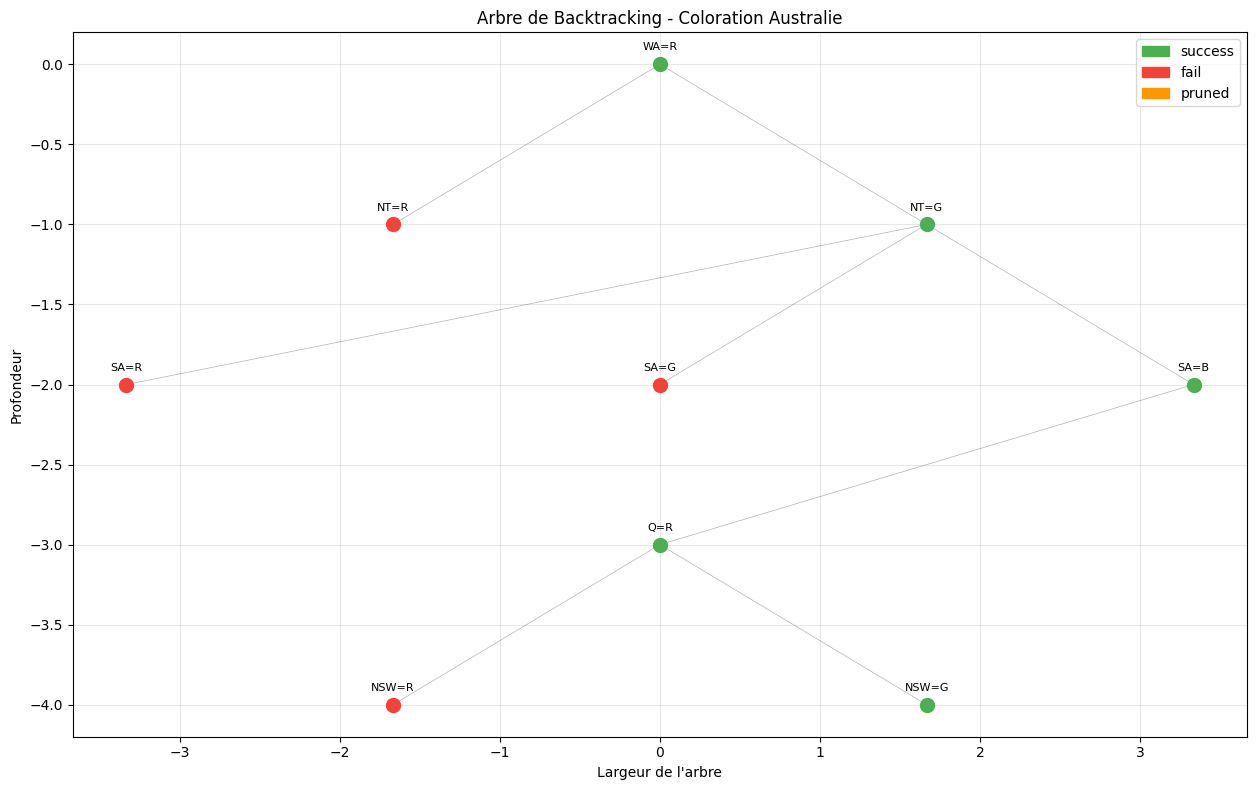
    def draw(self, max_depth=6, title="Arbre de Backtracking"):
        """Dessine l'arbre de recherche."""
        fig, ax = plt.subplots(1, 1, figsize=(14, 8))

        if not self.nodes:
            ax.text(0.5, 0.5, "Aucun noeud a afficher", ha='center', va='center')
            ax.set_title(title)
            return

        # Filtrer par profondeur
        filtered_nodes = [(i, n) for i, n in enumerate(self.nodes) if n[0] <= max_depth]

        # Positionnement des noeuds
        depth_nodes = defaultdict(list)
        for idx, (depth, var, value, status) in filtered_nodes:
            depth_nodes[depth].append((idx, var, value, status))

        positions = {}
        max_width = max(len(nodes) for nodes in depth_nodes.values()) if depth_nodes else 1

        for depth, nodes_at_depth in depth_nodes.items():
            n = len(nodes_at_depth)
            for i, (idx, var, value, status) in enumerate(nodes_at_depth):
                x = (i - (n-1)/2) / max_width * 10
                y = -depth
                positions[idx] = (x, y)

        # Dessiner les aretes
        for parent, child in self.edges:
            if parent in positions and child in positions:
                x1, y1 = positions[parent]
                x2, y2 = positions[child]
                ax.plot([x1, x2], [y1, y2], 'k-', alpha=0.3, linewidth=0.5)

        # Dessiner les noeuds
        colors = {'success': '#4CAF50', 'fail': '#f44336', 'pruned': '#FF9800'}
        for idx, (depth, var, value, status) in filtered_nodes:
            x, y = positions[idx]
            color = colors.get(status, '#2196F3')
            ax.scatter(x, y, c=color, s=100, zorder=5)
            ax.annotate(f"{var}={value}", (x, y),
                       xytext=(0, 10), textcoords='offset points',
                       ha='center', fontsize=8)

        # Legende
        legend_patches = [mpatches.Patch(color=c, label=l)
                         for l, c in colors.items()]
        ax.legend(handles=legend_patches, loc='upper right')

        ax.set_title(title)
        ax.set_xlabel("Largeur de l'arbre")
        ax.set_ylabel("Profondeur")
        ax.grid(True, alpha=0.3)
        ax.set_aspect('equal')
        plt.tight_layout()
        plt.show()


def backtracking_with_viz(csp, assignment=None, viz=None, depth=0):
    """
    Backtracking avec visualisation de l'arbre de recherche.
    """
    if assignment is None:
        assignment = {}
    if viz is None:
        viz = BacktrackingVisualizer()

    # Verifier si toutes les variables sont assignees
    if len(assignment) == len(csp.variables):
        return assignment, viz

    # Choisir la prochaine variable (ordre simple)
    unassigned = [v for v in csp.variables if v not in assignment]
    var = unassigned[0]

    for value in csp.domains[var]:
        # Verifier la consistance via la methode CSP
        is_ok = csp.consistent(var, value, assignment)

        viz.record_assign(var, value, is_ok)

        if is_ok:
            assignment[var] = value
            result, viz = backtracking_with_viz(csp, assignment, viz, depth+1)
            if result is not None:
                return result, viz
            del assignment[var]
            viz.record_backtrack()

    return None, viz

print("Visualiseur de backtracking pret.")