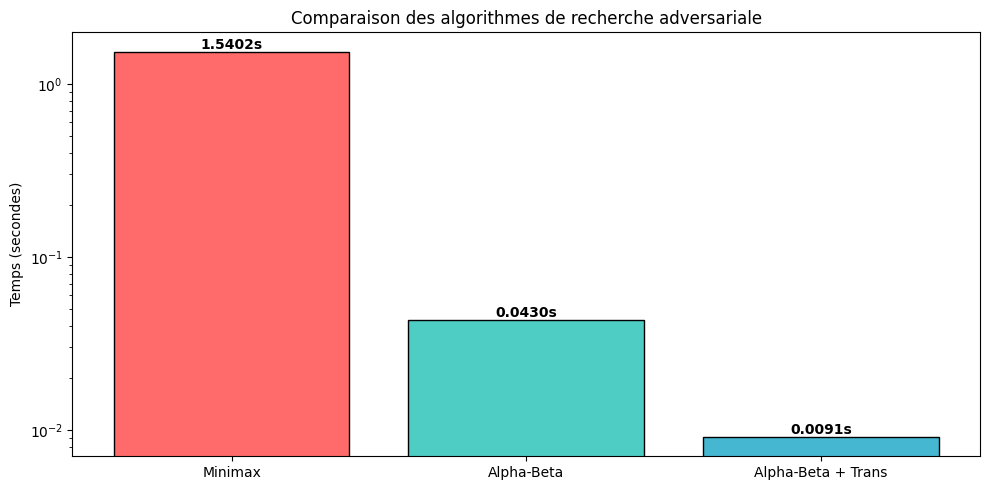
# --- §7.2 (m,n,k)-jeu : grille 5x5, aligner 4 pions (arbre minimax EXPLOSIF) ---
# Les compteurs du §7.1 étaient à profondeur illimitée (conçus pour le Tic-Tac-Toe
# complet). Ici l'arbre est inexplorable : versions à PROFONDEUR LIMITÉE (coupure à
# `prof`, heuristique neutre = utilité — le point est le COMPTE de nœuds, pas la valeur).

class JeuMNK(JeuSommeNulle):
    """(m,n,k)-jeu : grille m x n, aligner k pions. État = tuple hashable."""

    def __init__(self, m=5, n=5, k=4):
        self.m, self.n, self.k = m, n, k
    def etat_initial(self):
        return tuple([0] * (self.m * self.n))
    def actions(self, etat):
        return [i for i, v in enumerate(etat) if v == 0]
    def resultat(self, etat, action):
        joueur = 1 if etat.count(1) <= etat.count(2) else 2   # MAX (X) commence
        return etat[:action] + (joueur,) + etat[action+1:]
    def joueur(self, etat):
        return 'MAX' if etat.count(1) <= etat.count(2) else 'MIN'
    def _aligne(self, etat, pion):
        m, n, k = self.m, self.n, self.k
        for r in range(m):
            for c in range(n):
                if etat[r * n + c] != pion:
                    continue
                for dr, dc in ((0, 1), (1, 0), (1, 1), (1, -1)):
                    rr, cc, longueur = r, c, 0
                    while 0 <= rr < m and 0 <= cc < n and etat[rr * n + cc] == pion:
                        longueur, rr, cc = longueur + 1, rr + dr, cc + dc
                    if longueur >= k:
                        return True
        return False
    def est_terminal(self, etat):
        return self._aligne(etat, 1) or self._aligne(etat, 2) or 0 not in etat
    def utilite(self, etat, joueur='MAX'):
        gagne_max, gagne_min = self._aligne(etat, 1), self._aligne(etat, 2)
        if joueur == 'MAX':
            return 1 if gagne_max else (-1 if gagne_min else 0)
        return 1 if gagne_min else (-1 if gagne_max else 0)
    def afficher(self, etat):
        sym = {0: '.', 1: 'X', 2: 'O'}
        return '\n'.join(' '.join(sym[etat[r * self.n + c]] for c in range(self.n))
                         for r in range(self.m))

_cpt_prof = {"minimax": 0, "alpha_beta": 0, "transposition": 0}

def minimax_prof(jeu, etat, prof, joueur_max='MAX'):
    _cpt_prof["minimax"] += 1
    if jeu.est_terminal(etat) or prof == 0:
        return jeu.utilite(etat, joueur_max)
    actions = jeu.actions(etat)
    if jeu.joueur(etat) == joueur_max:
        return max(minimax_prof(jeu, jeu.resultat(etat, a), prof - 1, joueur_max) for a in actions)
    return min(minimax_prof(jeu, jeu.resultat(etat, a), prof - 1, joueur_max) for a in actions)

def alpha_beta_prof(jeu, etat, prof, alpha, beta, joueur_max='MAX'):
    _cpt_prof["alpha_beta"] += 1
    if jeu.est_terminal(etat) or prof == 0:
        return jeu.utilite(etat, joueur_max)
    actions = jeu.actions(etat)
    if jeu.joueur(etat) == joueur_max:
        v = float('-inf')
        for a in actions:
            v = max(v, alpha_beta_prof(jeu, jeu.resultat(etat, a), prof - 1, alpha, beta, joueur_max))
            alpha = max(alpha, v)
            if beta <= alpha:
                break
        return v
    v = float('+inf')
    for a in actions:
        v = min(v, alpha_beta_prof(jeu, jeu.resultat(etat, a), prof - 1, alpha, beta, joueur_max))
        beta = min(beta, v)
        if beta <= alpha:
            break
    return v

def alpha_beta_transpo_prof(jeu, etat, prof, alpha, beta, table, joueur_max='MAX'):
    _cpt_prof["transposition"] += 1
    if etat in table and table[etat][1] >= prof:
        return table[etat][0]
    if jeu.est_terminal(etat) or prof == 0:
        v = jeu.utilite(etat, joueur_max); table[etat] = (v, prof); return v
    actions = jeu.actions(etat)
    if jeu.joueur(etat) == joueur_max:
        v = float('-inf')
        for a in actions:
            v = max(v, alpha_beta_transpo_prof(jeu, jeu.resultat(etat, a), prof - 1, alpha, beta, table, joueur_max))
            alpha = max(alpha, v)
            if beta <= alpha:
                break
    else:
        v = float('+inf')
        for a in actions:
            v = min(v, alpha_beta_transpo_prof(jeu, jeu.resultat(etat, a), prof - 1, alpha, beta, table, joueur_max))
            beta = min(beta, v)
            if beta <= alpha:
                break
    table[etat] = (v, prof)
    return v

import time
jeu_large = JeuMNK(5, 5, 4)
print("Croissance des nœuds visités — jeu (5x5, aligner 4) selon la profondeur :")
print(f"{'prof':>5} | {'minimax':>14} | {'alpha-beta':>12} | {'+transposition':>15} | {'gain AB':>9} | {'gain +TT':>9}")
print("-" * 86)
for prof in [3, 4]:
    for cle in _cpt_prof:
        _cpt_prof[cle] = 0
    minimax_prof(jeu_large, jeu_large.etat_initial(), prof)
    n_mm = _cpt_prof["minimax"]
    alpha_beta_prof(jeu_large, jeu_large.etat_initial(), prof, float('-inf'), float('+inf'))
    n_ab = _cpt_prof["alpha_beta"]
    alpha_beta_transpo_prof(jeu_large, jeu_large.etat_initial(), prof, float('-inf'), float('+inf'), {})
    n_tt = _cpt_prof["transposition"]
    print(f"{prof:>5} | {n_mm:>14,d} | {n_ab:>12,d} | {n_tt:>15,d} | x{n_mm / n_ab:>7.1f} | x{n_mm / n_tt:>7.1f}")

# Profondeur 5 : le minimax explose (~6,7 millions, plusieurs minutes) — on ne lance QUE l'élagage.
for cle in _cpt_prof:
    _cpt_prof[cle] = 0
alpha_beta_prof(jeu_large, jeu_large.etat_initial(), 5, float('-inf'), float('+inf'))
n_ab5 = _cpt_prof["alpha_beta"]
alpha_beta_transpo_prof(jeu_large, jeu_large.etat_initial(), 5, float('-inf'), float('+inf'), {})
n_tt5 = _cpt_prof["transposition"]
N_MM5_MESURE = 6_693_626   # minimax exhaustif prof=5 mesuré hors-ligne (~minutes, non relancé en direct)
print(f"{'5':>5} | {'~' + format(N_MM5_MESURE, ',d') + ' (mesuré)':>14} | {n_ab5:>12,d} | {n_tt5:>15,d} | x{N_MM5_MESURE / n_ab5:>7.1f} | x{N_MM5_MESURE / n_tt5:>7.1f}")
print()
print("-> Le minimax est multiplié par ~22 à chaque niveau (14k -> 318k -> 6,7M) ;")
print("   l'alpha-beta+transposition ne l'est que par ~3-4 (672 -> 1,5k -> 8k).")
print("   L'écart EXPLOSE : c'est ici que l'élagage passe d'utile à INDISPENSABLE.")