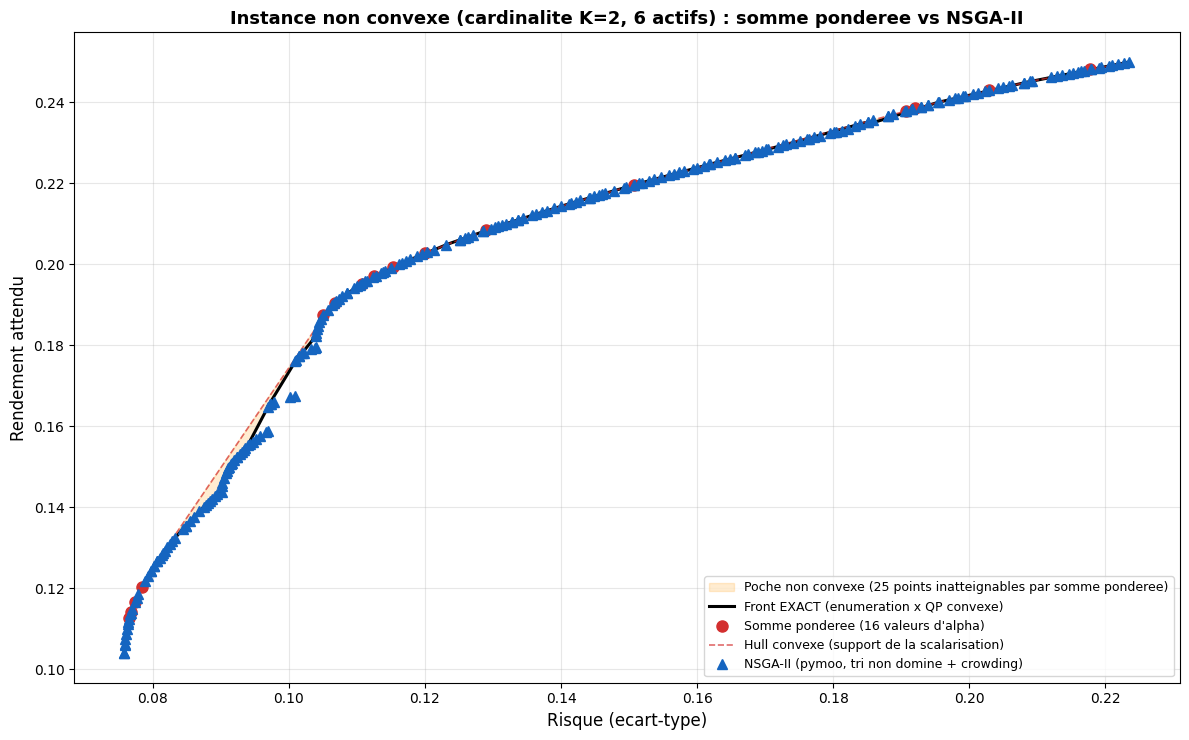
# --- Instance non convexe : mandat concentre 6 actifs, cardinalite K=2 ---
asset_names_c = asset_names + ["Hedge Funds"]
mu_c = np.array([0.05, 0.10, 0.15, 0.20, 0.25, 0.17])
sig_c = np.array([0.10, np.sqrt(0.02), np.sqrt(0.03), 0.20, np.sqrt(0.05), 0.11])
corr_c = np.array([
    [1.00, 0.10, 0.12, 0.15, 0.12, 0.05],
    [0.10, 1.00, 0.15, 0.16, 0.14, 0.08],
    [0.12, 0.15, 1.00, 0.30, 0.28, 0.10],
    [0.15, 0.16, 0.30, 1.00, 0.32, 0.12],
    [0.12, 0.14, 0.28, 0.32, 1.00, 0.15],
    [0.05, 0.08, 0.10, 0.12, 0.15, 1.00],
])
cov_c = np.outer(sig_c, sig_c) * corr_c
K_c = 2  # au plus 2 actifs


def project_topk_c(weights, k=K_c):
    """Projette un vecteur de poids continus sur la contrainte de cardinalite :
    conserve les k plus gros poids, renormalise."""
    w = np.maximum(np.array(weights, dtype=float), 0.0)
    if (w > 0).sum() > k:
        keep = np.argsort(w)[-k:]
        mask = np.zeros_like(w)
        mask[keep] = w[keep]
        w = mask
    total = w.sum()
    return w / total if total > 1e-12 else np.ones(len(w)) / len(w)


def ret_c(w):
    return float(w @ mu_c)


def risk_c(w):
    return float(np.sqrt(w @ cov_c @ w))


# Reference EXACTE : enumeration des paires x QP min-variance par cible de rendement.
t_start = time.time()
targets_c = np.linspace(mu_c.min(), mu_c.max(), 41)
exact_pts = []
for s in combinations(range(len(mu_c)), 2):
    mu_s = mu_c[list(s)]
    cov_s = cov_c[np.ix_(list(s), list(s))]
    for tgt in targets_c:
        if tgt < mu_s.min() - 1e-12 or tgt > mu_s.max() + 1e-12:
            continue
        wv = cp.Variable(2)
        p = cp.Problem(cp.Minimize(cp.quad_form(wv, cp.psd_wrap(cov_s))),
                       [cp.sum(wv) == 1, wv >= 0, mu_s @ wv >= tgt])
        p.solve(solver=cp.CLARABEL)
        if wv.value is not None:
            w2 = np.zeros(len(mu_c))
            w2[list(s)] = wv.value
            exact_pts.append((risk_c(w2), ret_c(w2)))
t_exact = time.time() - t_start

# Filtre non domine -> front exact
exact_all = np.array(sorted(exact_pts))
exact_front = []
best_r = -np.inf
for sg, rt in exact_all:
    if rt > best_r + 1e-9:
        exact_front.append((sg, rt))
        best_r = rt
exact_front = np.array(exact_front)
print(f"Reference exacte : {len(exact_pts)} points enumeres -> {len(exact_front)} non domines "
      f"({t_exact:.1f}s, {len(list(combinations(range(6), 2)))} paires x QP)")


# Mesure geometrique : quels points exacts sont atteignables par une somme ponderee ?
def scalarization_reachable(sig_f, ret_f, k):
    """Point k atteignable ssi il existe alpha > 0 dominant tous les autres points."""
    lo, hi = 0.0, np.inf
    num = ret_f[k] - ret_f  # R_k - R_i
    den = sig_f[k] - sig_f  # sigma_k - sigma_i
    for i, (n, d) in enumerate(zip(num, den)):
        if i == k:
            continue
        if abs(d) < 1e-14:
            if n <= 1e-12:
                return False
        elif d < 0:
            lo = max(lo, n / d)
        else:
            hi = min(hi, n / d)
    return hi > max(lo, 0.0)


reach_mask = np.array([
    scalarization_reachable(exact_front[:, 0], exact_front[:, 1], k)
    for k in range(len(exact_front))
])
n_unreach = int((~reach_mask).sum())
print(f"Points du front exact atteignables par somme ponderee (alpha > 0) : "
      f"{int(reach_mask.sum())}/{len(exact_front)}")
print(f"Points INATTEIGNABLES (sous le hull convexe) : {n_unreach} "
      f"-- aucune valeur d'alpha ne peut les rendre optimum")