def make_dataset(n_pos=80, n_neg=8000, seed=0):
    rng = np.random.default_rng(seed)
    X_pos = rng.normal(loc=[2.0, 2.0], scale=0.4, size=(n_pos, 2))
    X_neg = rng.normal(loc=[-1.0, -1.0], scale=1.5, size=(n_neg, 2))
    X = np.vstack([X_pos, X_neg]).astype(np.float32)
    y = np.hstack([np.ones(n_pos), np.zeros(n_neg)]).astype(np.float32)
    perm = rng.permutation(len(X))
    return torch.tensor(X[perm]), torch.tensor(y[perm])


Xtr, ytr = make_dataset(seed=1)
Xva, yva = make_dataset(seed=2)
print(f"train : {len(Xtr)} samples, {int(ytr.sum())} positifs ({100*ytr.mean():.2f}%)")
print(f"val   : {len(Xva)} samples, {int(yva.sum())} positifs ({100*yva.mean():.2f}%)")


class MLP(nn.Module):
    def __init__(self):
        super().__init__()
        self.net = nn.Sequential(
            nn.Linear(2, 32), nn.ReLU(),
            nn.Linear(32, 1)
        )

    def forward(self, x):
        return self.net(x).squeeze(-1)


def loss_share_per_class(model, X, y, loss_kind, gamma=2.0, alpha=0.5):
    """Part de la loss totale imputable aux positifs vs negatifs (batch).

    Pour chaque classe c : mean(loss_c) * |c| = perte non-réduite cumulée
    sur la classe. Total = somme sur les deux classes. Le partage par
    classe est (mean(loss_c) * |c|) / total — il reflète la
    **contribution absolue** de chaque classe à la loss totale,
    pondérée par la cardinalité. Avec 80 positifs et 8000 négatifs,
    un partage 50/50 signifierait mean(loss_pos) ≈ 100 * mean(loss_neg),
    ce qui est l'information recherchée.
    """
    model.eval()
    X = X.to(DEVICE); y = y.to(DEVICE)
    idx_pos = (y > 0.5).nonzero(as_tuple=True)[0]
    idx_neg = (y < 0.5).nonzero(as_tuple=True)[0]
    n_pos = len(idx_pos)
    n_neg = len(idx_neg)
    with torch.no_grad():
        if loss_kind == "bce":
            mean_pos = float(F.binary_cross_entropy_with_logits(model(X[idx_pos]), y[idx_pos]).item())
            mean_neg = float(F.binary_cross_entropy_with_logits(model(X[idx_neg]), y[idx_neg]).item())
        else:
            mean_pos = float(focal_loss(model(X[idx_pos]), y[idx_pos], gamma=gamma, alpha=alpha).item())
            mean_neg = float(focal_loss(model(X[idx_neg]), y[idx_neg], gamma=gamma, alpha=alpha).item())
    sum_pos = mean_pos * n_pos
    sum_neg = mean_neg * n_neg
    total = sum_pos + sum_neg
    return sum_pos, sum_neg, (sum_pos / total if total > 0 else 0.0)


def train_one(loss_kind, epochs=30, lr=1e-2, gamma=2.0, alpha=0.5):
    torch.manual_seed(42)
    model = MLP().to(DEVICE)
    opt = torch.optim.Adam(model.parameters(), lr=lr)
    hist_loss, hist_acc, hist_grad_norm = [], [], []
    for ep in range(epochs):
        model.train()
        opt.zero_grad()
        logits = model(Xtr.to(DEVICE))
        if loss_kind == "bce":
            loss = F.binary_cross_entropy_with_logits(logits, ytr.to(DEVICE))
        else:
            loss = focal_loss(logits, ytr.to(DEVICE), gamma=gamma, alpha=alpha)
        loss.backward()
        grad_sq = 0.0
        for p_ in model.parameters():
            if p_.grad is not None:
                grad_sq += float(p_.grad.detach().pow(2).sum())
        hist_grad_norm.append(grad_sq ** 0.5)
        opt.step()
        hist_loss.append(float(loss.detach()))
        model.eval()
        with torch.no_grad():
            preds = (torch.sigmoid(model(Xva.to(DEVICE))) > 0.5).float()
            tp = (preds * yva.to(DEVICE)).sum().item()
            npos = int(yva.sum().item())
            recall_pos = tp / max(npos, 1)
            acc = (preds == yva.to(DEVICE)).float().mean().item()
        hist_acc.append((acc, recall_pos))
    return hist_loss, hist_acc, hist_grad_norm, model


t0 = time.time()
bce_loss, bce_acc, bce_grad_norm, model_bce = train_one("bce", epochs=30)
fl_loss, fl_acc, fl_grad_norm, model_fl = train_one("focal", epochs=30, gamma=2.0, alpha=0.5)
print(f"2 entraînements × 30 époques en {time.time() - t0:.1f} s")

bce_lp, bce_ln, bce_lshare = loss_share_per_class(model_bce, Xtr, ytr, "bce")
fl_lp, fl_ln, fl_lshare = loss_share_per_class(model_fl, Xtr, ytr, "focal")
print(f"\nLoss share (modèles entraînés) :  BCE pos = {100*bce_lshare:.1f}%   Focal pos = {100*fl_lshare:.1f}%")

# Métrique gradient par classe — version honnête (cardinalité-pondéré + cosine).
# L'ancien `g_pos² / (g_pos² + g_neg²)` n'était PAS une part additive : la
# décomposition `||w_pos g_pos + w_neg g_neg||²` contient un cross term
# `2 w_pos w_neg <g_pos, g_neg>` qui peut être ± et faire basculer la "share".
# On reporte donc les deux énergies cardinalité-pondérées + la cosine similarité.
def _flat_grad(model):
    grads = [p_.grad.detach().reshape(-1) for p_ in model.parameters() if p_.grad is not None]
    return torch.cat(grads) if grads else torch.zeros(1)


def grad_class_metric(model, X, y, objective):
    """||w_pos g_pos||², ||w_neg g_neg||², cosine(g_pos, g_neg).

    Mesure cardinalité-pondérée : w_c = |c| / n_total. Le cross term
    `2 w_pos w_neg <g_pos, g_neg>` est explicitement hors du print car
    il peut basculer le signe de la "share".
    """
    X = X.to(DEVICE); y = y.to(DEVICE)
    idx_pos = (y > 0.5).nonzero(as_tuple=True)[0]
    idx_neg = (y < 0.5).nonzero(as_tuple=True)[0]
    n_pos, n_neg = len(idx_pos), len(idx_neg)
    n_total = n_pos + n_neg
    w_pos = n_pos / n_total
    w_neg = n_neg / n_total
    for p_ in model.parameters():
        if p_.grad is not None:
            p_.grad = None
    if n_pos > 0:
        objective(model(X[idx_pos]), y[idx_pos]).backward()
        g_pos = _flat_grad(model)
    else:
        g_pos = torch.zeros(0)
    for p_ in model.parameters():
        if p_.grad is not None:
            p_.grad = None
    if n_neg > 0:
        objective(model(X[idx_neg]), y[idx_neg]).backward()
        g_neg = _flat_grad(model)
    else:
        g_neg = torch.zeros(0)
    g_pos_norm = float(g_pos.norm().item()) if g_pos.numel() > 0 else 0.0
    g_neg_norm = float(g_neg.norm().item()) if g_neg.numel() > 0 else 0.0
    e_pos = (w_pos * g_pos_norm) ** 2
    e_neg = (w_neg * g_neg_norm) ** 2
    if g_pos.numel() > 0 and g_neg.numel() > 0:
        cos = float(torch.nn.functional.cosine_similarity(
            g_pos.unsqueeze(0), g_neg.unsqueeze(0)
        ).item())
    else:
        cos = 0.0
    return e_pos, e_neg, cos


bce_e_pos, bce_e_neg, bce_cos = grad_class_metric(
    model_bce, Xtr, ytr, lambda l, t: F.binary_cross_entropy_with_logits(l, t))
fl_e_pos, fl_e_neg, fl_cos = grad_class_metric(
    model_fl, Xtr, ytr, lambda l, t: focal_loss(l, t, gamma=2.0, alpha=0.5))
print(f"\nGradient par classe (cardinalité-pondéré, modèles entraînés) :")
print(f"  BCE : ||w_pos g_pos||² = {bce_e_pos:.6f}   ||w_neg g_neg||² = {bce_e_neg:.6f}   cos(g_pos, g_neg) = {bce_cos:+.3f}")
print(f"  FL  : ||w_pos g_pos||² = {fl_e_pos:.6f}   ||w_neg g_neg||² = {fl_e_neg:.6f}   cos(g_pos, g_neg) = {fl_cos:+.3f}")
print(f"  Note : cross term `2 w_pos w_neg <g_pos, g_neg>` est ± — `pos share` additive n existe pas.")
print(f"Grad norm epoch 0  :  BCE = {bce_grad_norm[0]:.3f}   Focal = {fl_grad_norm[0]:.3f}")
print(f"Grad norm epoch 29 :  BCE = {bce_grad_norm[-1]:.3f}   Focal = {fl_grad_norm[-1]:.3f}")

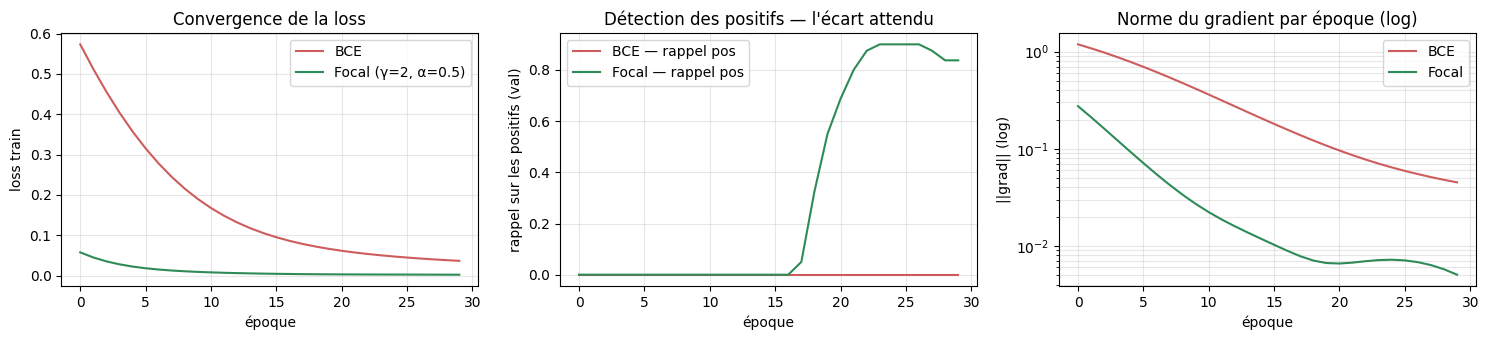
fig, axes = plt.subplots(1, 3, figsize=(15, 3.5))
axes[0].plot(bce_loss, label="BCE", color="indianred")
axes[0].plot(fl_loss, label="Focal (γ=2, α=0.5)", color="seagreen")
axes[0].set_xlabel("époque"); axes[0].set_ylabel("loss train")
axes[0].set_title("Convergence de la loss"); axes[0].legend(); axes[0].grid(alpha=0.3)

axes[1].plot([a[1] for a in bce_acc], label="BCE — rappel pos", color="indianred")
axes[1].plot([a[1] for a in fl_acc], label="Focal — rappel pos", color="seagreen")
axes[1].set_xlabel("époque"); axes[1].set_ylabel("rappel sur les positifs (val)")
axes[1].set_title("Détection des positifs — l'écart attendu")
axes[1].legend(); axes[1].grid(alpha=0.3)

axes[2].plot(bce_grad_norm, label="BCE", color="indianred")
axes[2].plot(fl_grad_norm, label="Focal", color="seagreen")
axes[2].set_yscale("log")
axes[2].set_xlabel("époque"); axes[2].set_ylabel("||grad|| (log)")
axes[2].set_title("Norme du gradient par époque (log)")
axes[2].legend(); axes[2].grid(alpha=0.3, which="both")
plt.tight_layout(); plt.show()

print(f"\nRappel final sur les positifs :  BCE = {bce_acc[-1][1]:.2f}   |   Focal = {fl_acc[-1][1]:.2f}")
print(f"Accuracy globale finale       :  BCE = {bce_acc[-1][0]:.3f}   |   Focal = {fl_acc[-1][0]:.3f}")